Pench – The Mowgli land!
Pench – the Mowgli land – the land of tigers – land of forests. District Seoni of Madhya Pradesh and portion of Maharashtra make the Pench forest. River Pench flows through the forest, from this river the forest gets its name.
We took Delhi bound Tamil Nadu express from Chennai Central at 10 pm on 20/11/2018, Tuesday. We are heading to Nagpur, a 16 hours journey. From Nagpur to Pench is a 90 km road journey that we covered by car.
We booked a budget scale resort in Penach called Banyan Tree Camp. The owner is a Bong from Serampore, Suman Manna, who had fallen in love with forests at a very young age. He speaks Bangla, but married in MP and settled there itself.
What came noticeable for me just after coming out of Nagpur station is the array of shops selling agricultural items. Seeds, pesticides, tools – what not! Evident that the area is majorly agriculture oriented.
Fields start from just the periphery of Nagpur city, and then, after a little while start the forest of Pench. But the road is a highway, hence forest does not come very near.
Madhya Pradesh starts at Khawasa. From here only, a small road goes leftward leading to our resort. It’s about 10 km away. This entire road is through forest. The night safari gate also falls on this road. Exit of night safari is from back of our resort. Evening 6 pm to 8.30 pm is timing for night safari. This we didn’t opt.
The main attraction of Banyan Tree Camp is its no-frill-attitude. There are four rooms altogether. Two pairs separated with open land in between. There is a big banyan tree, from which the resort derived its name. Tyre made, wooden swings, ladders etc are kept below the tree. The recreation options. A lot of open space is there inside the premises. Each room has a front and rear verandah. The rear verandah provides a view of the village and forest scenes at the back of the property where cattle graze and brass bells on their neck keep on tingling. I thought of bringing such a bell home. But we couldn’t visit the village weekly market where it comes.
The first two days of our stay Suman was not present in the resort. A few boys were managing everything and they managed it fantastic. They cook very tasty food, though bit spicy, but not hot. There was a local mango pickle – too good. This I brought a kilo, 130 bucks – nothing.
We reached around evening. They immediately brought water and wet towels for refreshment. It started becoming cold. The kids started running all around, no fear, no hesitation – just run and run.
We took four safaris in next two days – morning and evening. The first day’s two were from Turia gate in Madhya Pradesh and the last two from Khudsapar gate in Maharashtra.
We had to start by 5.15 am for morning safari, so we went to bed early.
It became 5.18 am by the time we could finally come out for Turia gate morning safari. Open Gypsy, fantastic cold, as the car ran, breeze became stronger on us. Both sets of parents held the kids in between them to keep them warm. This arrangement had to be changed a bit to give space to the guide after entering the forest.
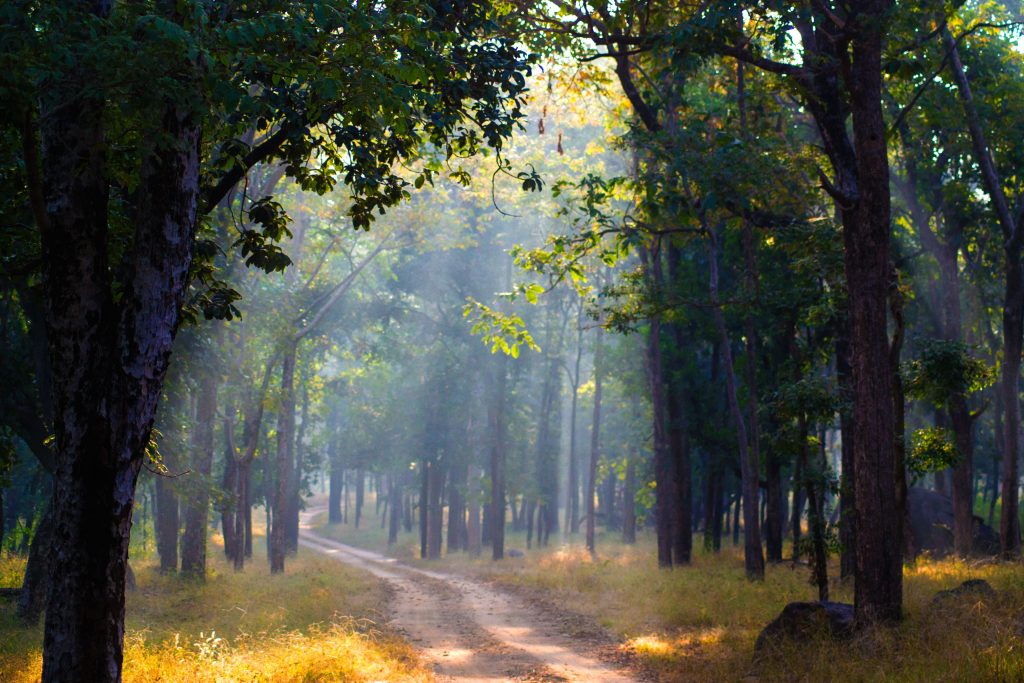
The forest through Turia is very beautiful. It’s not same all the ways. Somewhere it’s dense, somewhere there are open lands. The forest on the banks of River Pench is wide and spread. I felt it very romantic. At each corner the forest changes its appearance.
Here we could see spotted deer, sambar, wild owl, jackal, eagle, two tailed black bird, peacock etc.
Baby sambar came very near to the road with its curious big eyes wide open. Adult sambar also came like this.
Monkeys are troubled with their tails. They love to spread it across the road. Whenever vehicle comes, that first thing they sort out is to coil up their possession and ran sideward.
The peacocks had shed their monsoon tails and new small tails are appearing now. Similar for deer. They are getting new velvety horns now.
Curiously beautiful is this River Pench. A shallow water flows during this early winters. A very weak current. No hurry for anything. Laying as a quaint spread. There is no motorable road to cross the river. This means the forest on the other side is a more lone one. From our side of the bank we saw a big herd of spotted deer is crossing the river and coming towards us! Innumerous deer there were. They are approaching through the bank through several pathways, but finally descending into the river bed following a single narrow path in a well maintained queue. They were crossing the eater till a certain distance and then drinking water at a certain place near to our side of the bank. We felt it strange that they were not taking water at the first available spot itself. Our guide explained the probabilities – the waters everywhere in the river are not same. It’s not only the matter of cleanliness, tastes also vary from point to point. Considering all the points only the herd decides from where they can drink. How true is it! The forest knowledge inherited by genes.
I fantasized to keep on sitting on the banks of this River Pench on a moonlit night. Geography – environment – atmosphere – situation, everything is different, still I was recalling my first visit to River Jayanti that I saw in night. River Pench – Hindi word for spiraling – flows spiraling its way – and hence, gets its name.
In a nearby water body we spotted fishing eagle, concentrating on the water. A kingfisher kept on trying to disturb the eagle so that the prey won’t get shared – without any avail. Nothing could bother the eagle.
In this safari we didn’t see any tiger.
We took our resort brought breakfast in a clearing meant for this inside forest. There are good restrooms here. There is a small souvenir shop also and we purchased a few things.
We could not visit the interpretation center at Turia gate. From the shop keeper here it seemed that is closed for some time for some reasons. But we could not make any point for sure.
We returned to resort by 11 am. Our next safari is again from Turia by 2 pm.
In this safari, our guide tried a lot to spot a tiger – at least that what he shown, but of no avail. The forest changes its colors almost hourly, but we felt the morning safari was the better one.
In this evening safari we stopped for a while at the elephant camp of forest department. There is a small half open bamboo enclosure here to be used as washroom. Quite pathetic.
On our return to the resort we took tea and alu-chop (potato snack) from a shop in Turia village. They were good. By 6 pm we reached resort.
We spent two of our four safaris and there was no tiger sighting. Thus our chance to spot a tiger became just half. With this half chance only we took the morning safari next day through Khudsapar gate. This is the Maharashtra side of Pench forest. We got a lovely lady as our guide. We were half drained by then, and still in a lookout to spot the big.
The forest here is very dense, there is no open land anywhere. We can’t see anything after a bit distance. Other animals sighting is not much probable here, only the tigers.
Both the guides of previous day kept on explaining and cheering us up through their speech. This lady seldom opens her mouth. The driver and the guide saw something together and told that a tiger has crossed the road. Very good, but we are not cheered up, we had been hearing this throughout the previous day.
But after a little proceeding, suddenly our guide told, “see, it’s sitting there”. – what! But, yes, actually it’s there on the bank of a water hole. A tigress of around 4 years of age – Baras. We were the first to spot it.

We stood still. Only sound is from clicking of camera. Bother kids were fast asleep what was actually a boon at this moment. Then came more cars.
She once sits, once stands, yawns, drinks water – total leisure. Then she started walking through the canal – slowly and steadily. The convoy of cars started following her through the bank of the canal. There also once she sits, once stands and so on. Then she disappeared through the canal itself.
Our guide told that it’s not adult yet and still with her mother. She has not marked her territory yet. A tiger will be bigger than this. Head will be of a flat pot. Paw print of a tigress is rectangular, but for a tiger it’s square.
How tigers mark their territory! They stand on the hind legs near a tree and stretch their full body length to reach the highest point possible on the tree. There they scratch. This shows how big they are. When another tiger comes into the marked area, by seeing this scratch marks they know who is bigger! If the new comer is bigger, they think to stay in. But in the opposite case, the smaller one says a silent good bye and leaves.

We spotted such scratch marks on the trees.
The forest road here is very rough and a cloud of dust always follows you. We got exhausted. There is again a clearing where we stopped to take breakfast. The restroom here again is that bamboo enclosure and as usual pathetic.
We reached at resort by 10 am. But today we were far more exhausted. It was really a tough task to go for that 2 pm safari again on the same day. Still somehow we went for it. This time we were trying to spot tiger at any cost and finally could not do it. No sighting of tiger. Nothing very special to mention. But some Indian gaur finally came into sight and just before coming out of the gate, there we saw a neel gai. These two animals we could not see in our previous safaris.
There is again a souvenir shop just outside of the gate, and again we shopped tit-bits.
On the way return to resort we stopped at a tea shop, inaugurated on that day only, beside Kohka lake. We climbed the bund of the lake to have a sight of it.
A big, red, round moon of the full moon night rose opposite of the lake.
After reaching resort it was not possible for anybody to carry on anything further.
The lunch on this day was a sort of activity. They prepared the food in clay pots, on clay oven using wood and dry leaves as fuel. The food was served on ground under the banyan tree on leaf. A fun to have.
Suman has returned by then. We’d have to talk to him. Next day is our return. Hence packing to be finished. There is a plan to visit the potters’ village Pachdhar next morning. But body is asking only for sleep.
Anyway, we could do all one by one. Suman brought forest honey from Kanha. It’s a mix of honey from honey combs from trees, structures and soil. The local tribesmen over there gather it from Kanha forest, probably not from core, but from buffer zones.
There was some discussion. And there came the plan to visit Pachdhar next morning.
Finally I, Kritika and Riya only went to Pachdhar. Suman came along. Gypsy took the same forest road connecting our resort to Khawasa. While coming it was almost dusk, now it’s morning. Then it was becoming cold, now it’s warming up. It was an AC Xylo that time, now it’s an open Gypsy. The journey is far more enchanting now. In this journey we soaked ourselves to the trees. We saw the katha tree, kendu tree, mahua tree, arjun tree, and lot of shal and segun – the teaks.
There is something called ghost tree. By shedding its bark, it takes three different colors – white, pink and brown – in annual span. One beautiful of this type we saw in Kudsapar forest. There was a small branch from which all the barks had not fallen by then. Some are still hanging. Too beautiful to behold.
Suman told, originally Pench forest was very very beautiful. But while leaving India, the British took all the teak trees from Pench. The forest became void. The present forest is a young one. Maybe of 60-70 years old trees are there. The Kudsapar section is even younger. Is it the reason that Turia appeared more attractive than Khudsapar! He told there are even 1000-1500 years old trees in Kanha forest! Sometime we’ll see.
Pachdhar is the potters’ village. We went to a house. They showed how to make pottery. Here they used electric potting wheel. The manual ones are there, elder potters still use them, but present generation works on the electric one. We also tried our hands on the wheel and made something like cup or lamp etc.
We purchased a lot of things from there. They are not costly. They are really beautiful. The only constrain is how to carry them home! This restricted our picking things up.
Suman brought a lot of their wasted or rejected items. He can give little touch ups here and there and they’ll become beautiful. He’ll use them for his resort.
Our return path to resort was through typical Madhya Pradesh villages, by giving pass to goat kids and chicks. From a shop on the way we could get that fantastic pickle. And a bottle of mahua from a tribal home.
We returned – then, anyway we returned.